
Begin with the cat in front of you
There is no single timetable that suits every cat. Age, health, household relationships and individual preferences all matter. FelineVMA’s guidance on indoor cats emphasizes meeting species-specific needs while considering the individual animal and the household.
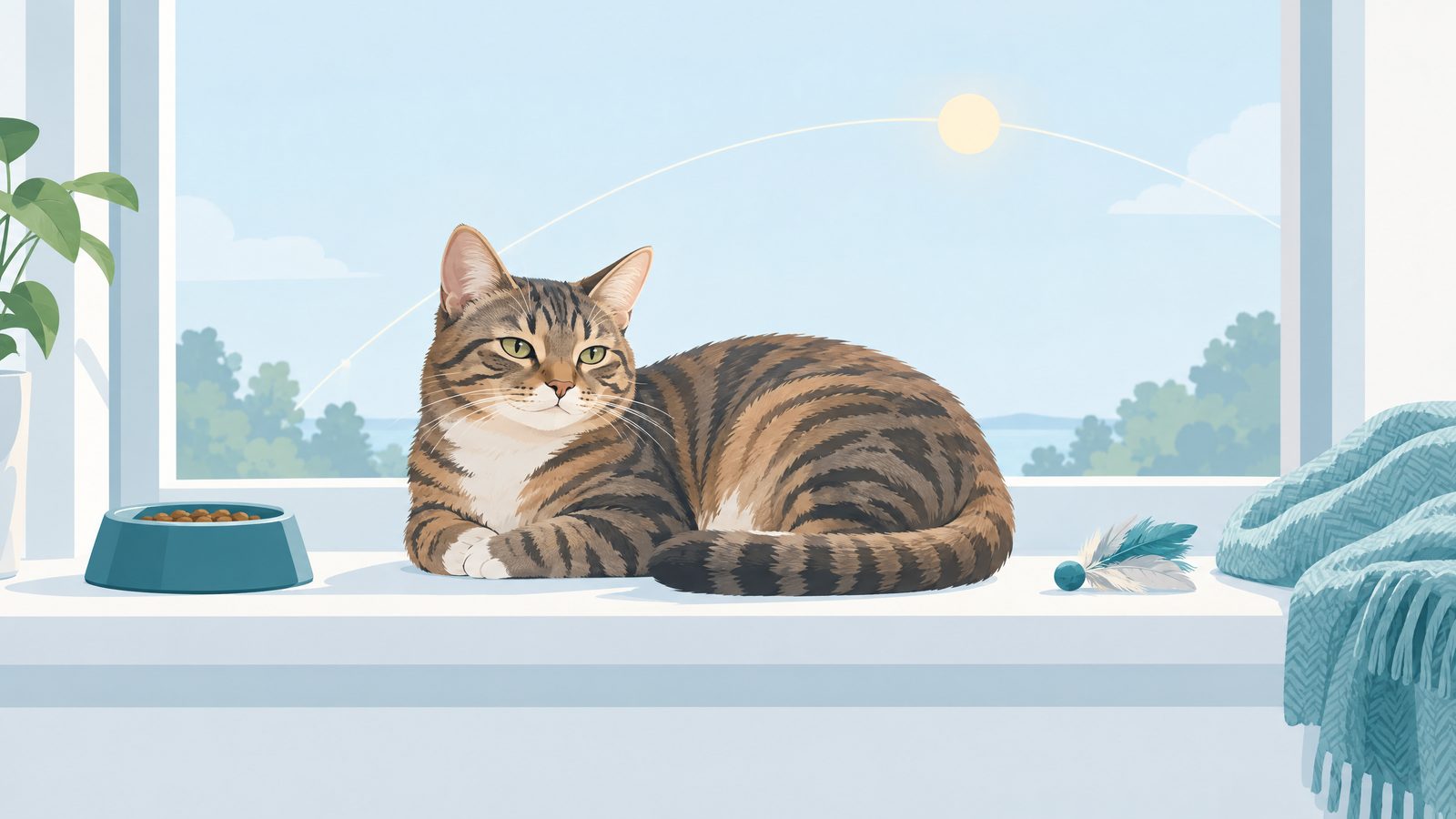
Instead of forcing a fixed schedule, start by noticing where your cat rests, when they approach you and which activities they choose. In a multi-cat home, observe each cat separately; sharing an address does not mean every cat wants to share every resource.
Make the environment part of the routine
The feline environmental-needs framework describes five areas: a safe place, separated resources, opportunities for play and predatory behavior, positive predictable interaction, and an environment that respects a cat’s sense of smell.
Use those areas to look around your home. Can your cat retreat without being followed? Are feeding, drinking, resting and litter resources arranged so each cat can use them comfortably? Is there a choice of places to pause and observe? These questions are more useful than buying an accessory without considering where or how the cat will use it.
Offer play and interaction with choice
Make room for play that suits your cat’s interest and ability. Notice whether they engage, pause or move away. Predictable opportunities for interaction are different from insisting on contact at a particular time. Let your cat’s response help shape the routine.
Keep the environment and sensory experience in mind when introducing a change. If a routine is not working, look at the whole setting rather than assuming the cat is simply refusing to cooperate.
Record changes without guessing the cause
A simple observation note can include eating, drinking, litter use, play, sleep locations and social interaction. Compare what you see with your own cat’s usual behavior. The note is a record to discuss, not a diagnostic checklist.
When a change concerns you, contact your veterinary practice and describe when it began and what else changed around the same time. Do not assume a new behavior is only a preference or only a medical problem based on an article.
A routine you can adapt
Review what is working as your cat ages or the household changes. Keep the parts your cat uses and reconsider the parts they avoid. Your veterinarian can help put observations in the context of health and individual needs.
Browse cat care resources or the behavior collection for related guidance.
Tom B.
Sixteen hours of sleep a day sounded like a lot until I actually tracked my cat for a weekend. She hit it easily.
Aisha N.
My cat's routine flipped after we moved apartments — she's active at 3 a.m. now. How long should I wait for things to settle before mentioning it to the vet?
Veterinarians.org Editorial Team
A move is a big routine change, but we can't say from here what's normal for your cat. If the night activity keeps up or she changes in other ways the article describes, that's exactly the kind of shift worth describing to your veterinarian.
Grace L.
The point about grooming changes being an early signal was new to me. My older cat grooms less than she used to and I'd chalked it up to age.
Diego M.
Is it better to schedule play sessions at the same time every day, or does varying it keep an indoor cat more engaged?
Hannah F.
Two cats, completely different routines. One patrols the whole house all morning, the other barely leaves the bedroom. Reading this, I guess the key is knowing what's normal for each of them?